
Behavioral Health Foundations
Behavioral health awareness, trauma-informed care, recovery orientation, person-centered interaction, stigma reduction, and the transportation role in continuity of care.
Aquila’s safety model integrates workforce screening, structured education, competency assessment, acuity-based planning, discreet vehicle configurations, 24/7 human oversight, and RSN-supported controls for assignment, documentation, incident governance, and measurable quality assurance.
Transport Specialists receive role- and program-specific preparation centered on calm communication, behavioral awareness, safe decision-making, professional boundaries, and consistent documentation.
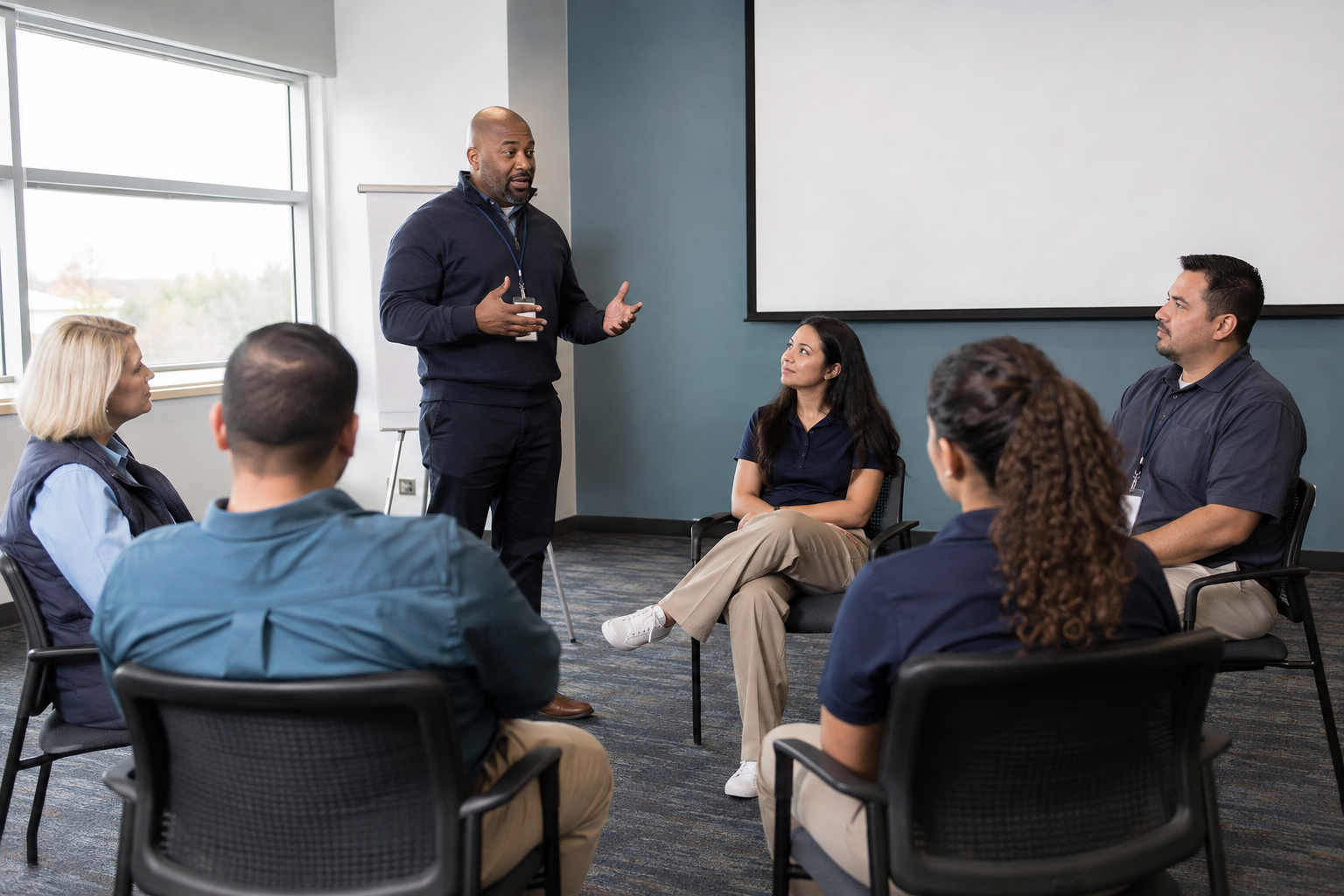
A safe transportation model should minimize trauma as well as physical risk. Aquila uses calm communication, the least restrictive appropriate configuration, professional civilian presentation, defined escalation procedures, and active operational oversight.
Transport Specialists are not presented as police officers, security guards, or ambulance clinicians. Their role is to complete authorized transportation safely, respectfully, and consistently within defined legal, contractual, and professional boundaries.
The core curriculum is supplemented by contract, jurisdiction, passenger-population, and vehicle-specific requirements.
Training is assigned by role, passenger population, jurisdiction, service type, and contract. State or program-specific requirements are added to the Aquila core curriculum before assignment.
Behavioral health awareness, trauma-informed care, recovery orientation, person-centered interaction, stigma reduction, and the transportation role in continuity of care.
Nationally recognized crisis-intervention coursework, verbal de-escalation, behavioral observation, situational awareness, environmental control, and safe disengagement.
Recognition of common mental health conditions, supportive communication, warning signs, immediate safety concerns, escalation, and connection to appropriate resources.
Substance-use awareness, impairment indicators, withdrawal concerns, overdose recognition, stigma-free interaction, professional boundaries, and emergency escalation.
Age-appropriate communication, guardian coordination, mandated reporting, dementia awareness, developmental considerations, vulnerability, and passenger-specific planning.
Immediate lifesaving response within training, emergency recognition, scene safety, 911 activation, dispatch notification, and post-event documentation.
Defensive driving, hazard recognition, adverse weather, fatigue management, backing, following distance, passenger comfort, route discipline, and accident response.
HIPAA awareness, minimum-necessary communication, secure documents and devices, appropriate radio use, records handling, privacy, and breach reporting.
Legal-document verification, competency evaluation and restoration processes, chain of custody, court and law-enforcement coordination, restrictions, and documented transfers.
Ethics, nondiscrimination, cultural humility, disability awareness, professional boundaries, sexual-harassment prevention, abuse prevention, and respectful communication.
Safe entry and exit, mobility assistance, wheelchair procedures, belongings, prohibited items, seating, seatbelts, comfort, and reasonable accommodations.
Time stamps, mileage, status changes, refusals, delays, deviations, restraints, elopements, injuries, complaints, notifications, and complete objective narratives.
Every listed qualification area is required, renewed annually, and verified through knowledge testing and field validation. The qualified instructor or issuing organization varies with the approved core program.
| Qualification area | Requirement | Renewal | Knowledge standard | Practical standard |
|---|---|---|---|---|
| Behavioral-health and trauma-informed foundations | Required | Annual | 80% minimum | Field validated |
| Verbal de-escalation and behavioral observation | Required | Annual | 80% minimum | Field validated |
| Recognized crisis-intervention program | Required | Annual | 80% minimum | Field validated |
| Mental-health first aid, suicide awareness, and escalation | Required | Annual | 80% minimum | Field validated |
| Substance-use and recovery-support awareness | Required | Annual | 80% minimum | Field validated |
| CPR, AED, first aid, and emergency action | Required | Annual | 80% minimum | Field validated |
| Defensive and passenger-safe driving | Required | Annual | 80% minimum | Field validated |
| Privacy, confidentiality, and documentation | Required | Annual | 80% minimum | Field validated |
| Vehicle configuration, mobility, and passenger assistance | Required | Annual | 80% minimum | Field validated |
| Youth, older-adult, guardian, and cognitive-needs procedures | Required | Annual | 80% minimum | Field validated |
| Court, competency, custody, and restraint procedures | Required | Annual | 80% minimum | Field validated |
| Professional conduct, cultural competency, and incident reporting | Required | Annual | 80% minimum | Field validated |
Verify eligibility, background, driving qualification, and role requirements.
Complete the full required curriculum through qualified instructors or approved organizations.
Achieve at least 80% and pass practical, scenario, and supervised-field evaluation.
Supervisory review and RSN-supported eligibility controls confirm required credentials before assignment.
Renew every requirement annually, with coaching and remediation whenever indicated.
ResponderShield Nexus (RSN) supports Aquila’s safety program across the transport lifecycle. It helps qualified personnel and 24/7 dispatch teams work from a consistent operational record without replacing professional judgment, direct communication, or supervisory responsibility.
Role requirements, completed training, credentials, renewal dates, and service-specific qualifications support appropriate crew selection before assignment.
Trip milestones, GPS-supported vehicle visibility, field communication, and status information help dispatch maintain awareness throughout the assignment.
Delays, refusals, cancellations, medical concerns, and operational incidents can be recorded, routed, and elevated with clear responsibility and time-stamped activity.
Transport records, handoff information, audit history, required documentation, and performance data support supervisory review, quality assurance, and continuous improvement.
Transport Specialists complete a nationally recognized crisis-intervention program—such as CPI Nonviolent Crisis Intervention or an approved equivalent—together with applicable state, agency, and program coursework.
Screening is completed in accordance with applicable law, contract, jurisdiction, role, and passenger population.
Identity, work authorization, employment history, qualifications, and role-specific credentials.
Applicable national, state, local, and contract-required criminal-history screening.
Applicable abuse, neglect, sex-offender, exclusion, professional, or other required registries.
License verification, motor-vehicle record, insurability, defensive-driving preparation, and ongoing monitoring.
Pre-assignment and other testing as required by policy, law, contract, reasonable suspicion, or post-incident procedure.
Training completion, knowledge checks, practical evaluation, field validation, and supervisor authorization.
Aquila uses a soft professional uniform designed to reassure passengers while allowing facilities and authorized partners to verify personnel identity.
Vehicles are selected and configured according to passenger mobility, authorization, acuity, distance, staffing, and contract requirements.
Unmarked or minimally marked vehicles without law-enforcement styling, emergency graphics, or unnecessary external identification.
Secured and non-secured options, safety partitions where appropriate, controlled passenger areas, seatbelts, child-safety equipment, and hazard mitigation.
GPS-supported oversight, continuous dispatch communication, route monitoring, status updates, and documented deviations.
AED, first aid supplies, fire extinguisher, emergency contact procedures, and equipment appropriate to the service model.
Preventive maintenance, daily readiness inspections, defect reporting, sanitation, replacement vehicles, and outage contingencies.
Wheelchair-accessible vehicles and passenger-assistance configurations when needs can be served without ambulance-level care.
Staffing and vehicle configuration are matched to the authorized transportation plan. Routine movements may use one Transport Specialist and a non-secured vehicle. Increased acuity, youth, court, competency, elopement, mobility, or contract-defined needs may require two personnel or a secured configuration.
Safety partitions and restraint capability are available when authorized and appropriate, but they are not treated as the default experience for every passenger.
Restraint is never used for convenience, punishment, retaliation, intimidation, or merely because a person has a behavioral health diagnosis.
Our dispatch operation uses RSN to maintain a shared, time-stamped view of the transport while preserving direct human communication with field personnel and authorized partners.
Serious incidents are managed through defined immediate-action, notification, documentation, investigation, and corrective-action procedures.
Address immediate life safety, request emergency assistance, and stabilize conditions within training.
Contact dispatch, supervision, referring and receiving partners, authorities, and contract representatives as required.
Preserve time stamps, communications, statements, records, video, vehicle data, and objective incident details within the associated operational record.
Use the transport history and audit trail to support supervisory and quality review, identify contributing factors, and coordinate required investigation.
Implement policy, training, staffing, equipment, technology, or supervisory corrective action.
Monitor corrective-action completion and determine whether changes produced the intended result.
RSN-supported visibility into required courses, certifications, competency evaluations, continuing education, expiration dates, and assignment eligibility.
Injuries, vehicle incidents, elopements, restraint use, law-enforcement involvement, and procedure deviations.
Assignment, response, completion, cancellation, refusal, failed-transport, and preventable-delay performance.
Complaints, grievances, facility feedback, communication concerns, and documented resolution.
Inspections, maintenance compliance, defects, sanitation, equipment, vehicle outages, and replacement response.
Required fields, accurate time stamps, mileage, notifications, narratives, linked audit history, and record retention.
No. Transport Specialists are civilian transportation professionals. Aquila’s broader experience contributes operational discipline, but Specialty Transport personnel are trained, presented, and assigned for the transportation role.
No. Vehicle configuration is matched to the passenger, authorization, risk assessment, and contract. Partitions are available for appropriate secured transportation but are not necessary for every movement.
Training and credentials are documented by employee, role, course, completion date, expiration, competency result, and assignment eligibility. Supervisory review and RSN-supported eligibility controls help verify compliance before independent assignment and throughout service.
RSN connects qualification information, referral requirements, dispatch activity, trip milestones, operational exceptions, documentation, and quality review. It provides a consistent, reviewable record while Aquila personnel remain responsible for communication, judgment, escalation, and safe service delivery.
Aquila’s process requires current, applicable qualifications before independent assignment. RSN-supported eligibility controls help dispatchers and supervisors identify whether required credentials and service-specific qualifications are current before a crew is assigned.
Operational exceptions are documented with relevant status history, communications, time stamps, and follow-up actions. Significant concerns are escalated for supervisory review, and the resulting record can support investigation, corrective action, partner reporting, and quality improvement.
Personnel stop when safe, request 911, notify dispatch, provide assistance within their training, and coordinate with the referring and receiving entities. Specialty Transport does not substitute for ambulance care.